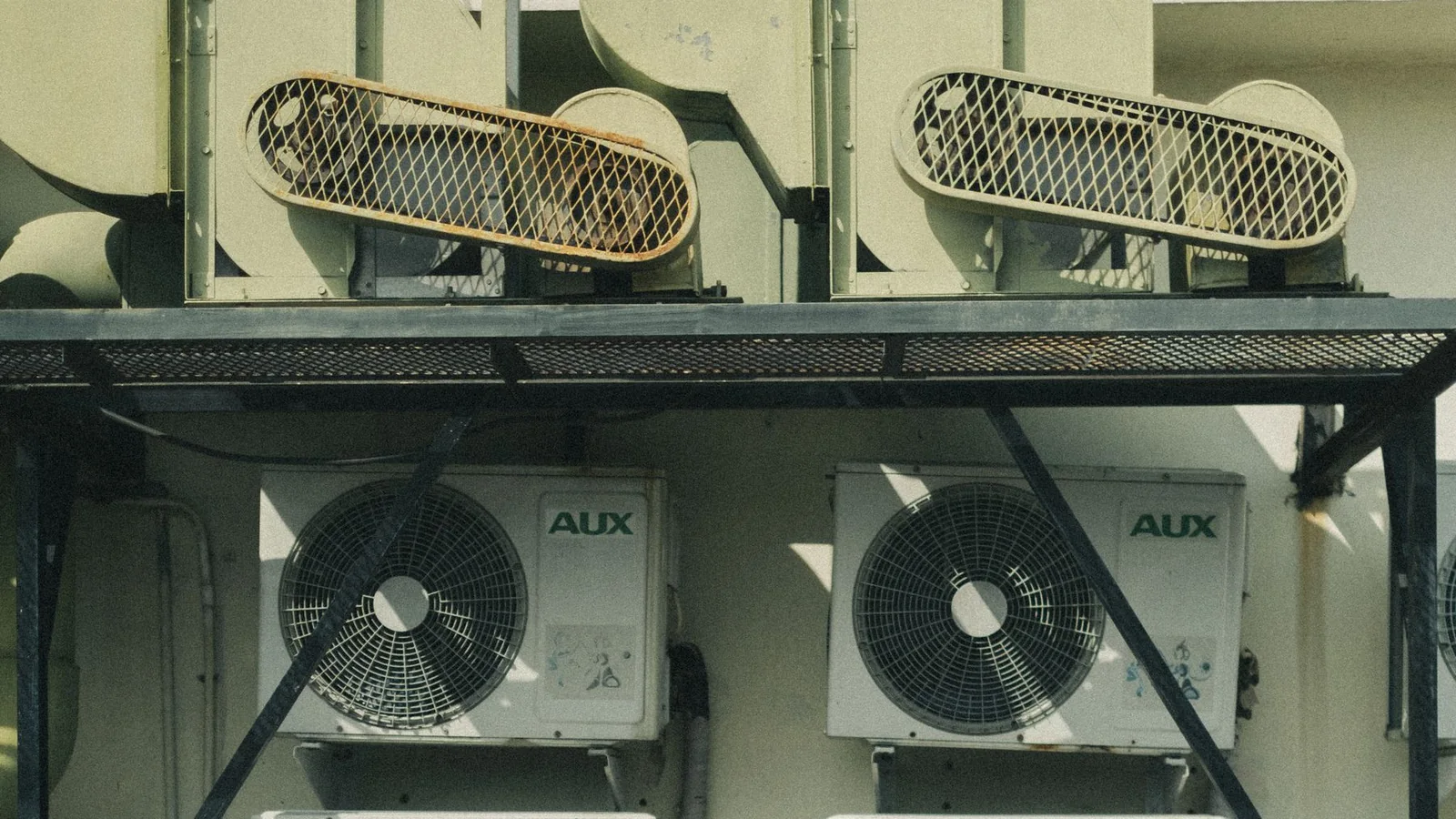
Ice on an air conditioner is not a sign that the system is producing extra-cold air. It usually means heat is not reaching the evaporator coil fast enough, or the refrigerant circuit is not operating correctly. The safest first response is to stop cooling, protect the equipment, and work through a few checks that do not require opening electrical or refrigerant components.
First: shut off cooling and let the ice melt
Switch the thermostat from Cool to Off. If the indoor fan can run without the outdoor unit, setting the fan to On may help move room-temperature air across the coil. Do not chip ice away, pour hot water onto the coil, or keep restarting the compressor. Carrier warns that continued operation with a frozen coil can damage the system.
Melting may take several hours. Watch for water around the air handler and protect finished floors. If water is approaching wiring or electrical equipment, shut the system down at the disconnect or breaker only if you can do so safely, then call a professional.
What a frozen air conditioner usually looks like
- Weak airflow or air that is no longer cool
- Frost on the large insulated copper line
- Ice on the indoor evaporator coil or cabinet
- Water near the furnace or air handler after the ice melts
- An outdoor unit that runs while indoor comfort gets worse
The visible ice may be outside, but the underlying problem often begins at the indoor coil.
Cause 1: restricted airflow
The evaporator coil absorbs heat from indoor air. When too little air crosses it, the coil temperature can fall below freezing and moisture on the coil becomes ice. Common airflow restrictions include a loaded filter, blocked return grille, closed supply registers, a dirty evaporator coil, or a blower problem.
Safe checks you can make
- Inspect the filter. Replace it if it is visibly loaded, damaged, wet, or past the manufacturer’s interval. Match the printed size and install it with the airflow arrow pointing toward the blower.
- Open the registers. Make sure supply vents and return grilles are not covered by rugs, furniture, boxes, or curtains.
- Look for obvious debris outdoors. Leaves and vegetation should not block the condenser coil. Do not remove panels or place tools inside the unit.
ENERGY STAR recommends inspecting, cleaning, or changing filters monthly and having a contractor check airflow, coils, and system controls during seasonal service.
Cause 2: a refrigerant or metering problem
Low refrigerant charge, a leak, or a restriction in the refrigerant circuit can lower pressure and temperature at the evaporator. The result may look similar to an airflow problem, but adding refrigerant is not a complete repair if the system is leaking.
This is not a homeowner procedure. Refrigerant work requires the right instruments, recovery practices, equipment-specific charging information, and—where federal rules apply—proper technician certification. Call a qualified HVAC contractor if the filter and vents are clear but icing returns.
Cause 3: blower, control, or sensor trouble
A failing blower motor, weak capacitor, damaged relay, incorrect thermostat command, or control-board fault can reduce or stop indoor airflow while the outdoor unit continues cooling. These failures may be intermittent, which is why a system can thaw and appear normal before freezing again.
Do not reach into the cabinet or test live components. HVAC equipment can retain hazardous voltage even after it is switched off.
When you can try cooling again
Once all visible ice has melted, the filter is clean, and the registers are open, you can make one short test. Return the thermostat to cooling and observe the system for roughly 15 to 30 minutes.
- Airflow should feel steady at several supply registers.
- The large refrigerant line may feel cool, but new frost should not form.
- Water should drain normally rather than pool around the equipment.
If ice returns, shut cooling off. Repeated thaw-and-restart cycles risk compressor damage and do not solve the cause.
Call an HVAC professional now if…
- The breaker trips, wiring smells hot, or you see scorch marks
- The blower is not moving air
- Icing returns after a clean-filter test
- You hear grinding, buzzing, hissing, or repeated hard starts
- Water is threatening ceilings, flooring, or electrical parts
- The system has a known refrigerant leak or recent repair
How to reduce the chance of another freeze-up
Check the filter regularly, keep return grilles and supply registers clear, maintain space around the outdoor unit, and schedule cooling service before peak season. A useful service visit should include coil condition, condensate drainage, blower airflow, electrical connections, controls, and refrigerant performance—not simply a quick visual inspection.
Use the pattern of ice as a clue—not a final diagnosis
| Observation | Possible explanation | Safe next step |
|---|---|---|
| Ice appears after a filter becomes heavily loaded | Restricted airflow may have lowered coil temperature | Turn cooling off, replace the correct filter, allow complete thawing, and monitor |
| Filter is clean but airflow is weak at many registers | Blower, coil, duct, damper, or return-air problem | Stop repeated operation and schedule airflow diagnosis |
| Only part of the coil or refrigerant line frosts | Refrigerant distribution, metering, charge, or restriction issue | Do not add refrigerant; have a qualified technician test the sealed system |
| System freezes during cool outdoor weather | Controls or operating conditions may be outside normal cooling design | Stop cooling and review manufacturer limits and control strategy |
| Ice returns soon after thawing | The underlying fault remains | Leave cooling off until it is diagnosed |
| Water overflows after thawing | Drain, pan, trap, pump, or installation problem | Protect finishes, shut equipment down, and correct drainage |
Ice location can narrow the investigation, but homeowners normally cannot see the full indoor coil safely. Panels may expose line voltage, moving parts, sharp metal, or microbial contamination. Photographs taken without removing secured service panels can help a technician, as can notes about outdoor temperature, thermostat setting, runtime, filter condition, and which rooms lost airflow.
Why “just add refrigerant” is the wrong shortcut
A correctly installed sealed system does not consume refrigerant like fuel. If the charge is low, there may be a leak, an earlier charging error, or another condition that measurements must distinguish. Adding refrigerant without weighing charge where required, checking temperatures and pressures under valid conditions, and investigating leakage can raise cost while leaving the cause unresolved.
Too much refrigerant can also damage performance. So can a dirty outdoor coil, incorrect airflow, metering fault, noncondensables, or mismatched equipment. A technician should establish airflow before drawing conclusions from refrigerant-side readings because the two sides of the system interact.
What a professional diagnosis should document
A useful service record goes beyond “unit frozen.” It identifies filter and coil condition, blower operation, total external static pressure where appropriate, temperature split under stable conditions, drain function, thermostat and sensor behavior, outdoor conditions, equipment model numbers, and refrigerant findings. If a leak is suspected, the record should distinguish detection from repair and explain whether the location is accessible and economically repairable.
After repair, the contractor should verify that the coil remains above freezing during normal operation, condensate drains correctly, airflow reaches the rooms, and controls cycle the system as intended. That confirmation is especially important when more than one fault existed—for example, a dirty filter plus a failing blower capacitor.
Ask for the final readings and the operating conditions under which they were taken. They create a baseline for future maintenance and make it easier to distinguish a recurring fault from a new problem.
Repair, redesign, or replace?
A first freeze caused by a neglected filter is different from repeated icing in an old system with a leaking coil, obsolete components, high energy use, and poor comfort. Compare repair cost, warranty, equipment age, leak location, refrigerant and parts availability, duct deficiencies, and expected remaining life. Replacement should still begin with a load calculation and duct assessment; copying the old nominal size can preserve the conditions that contributed to short cycling or humidity problems.
Sources and image credit
- Carrier: air conditioner troubleshooting and frozen-coil guidance
- ENERGY STAR: HVAC maintenance checklist
- U.S. Department of Energy: Energy Saver 101—Home Cooling
Featured photo by Lutfi Elyas on Pexels, used under the Pexels license.