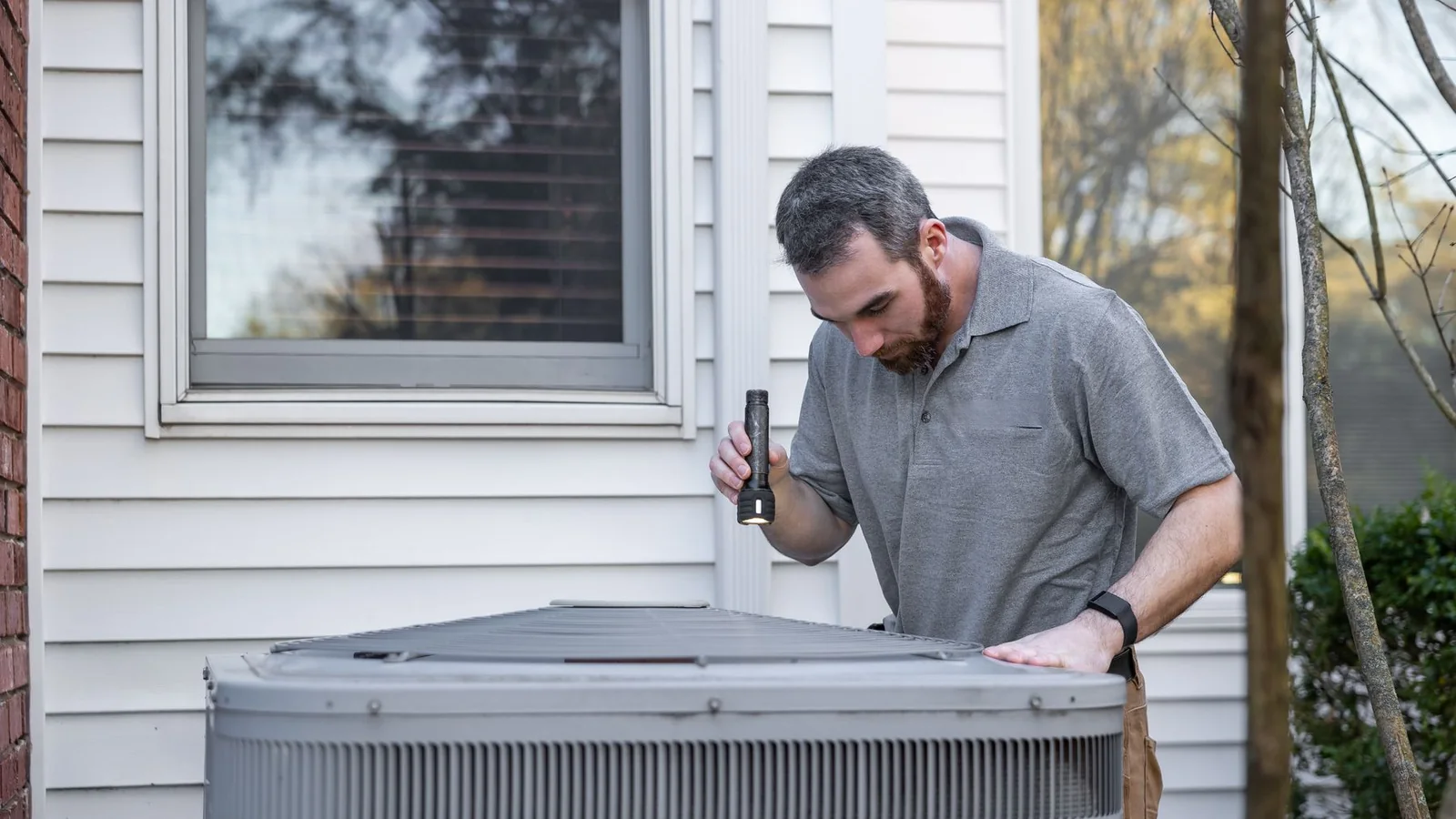
Seasonal HVAC maintenance works best when the homeowner handles simple observation and housekeeping while a qualified contractor handles measurements, electrical work, combustion checks, and the refrigerant circuit. Use this checklist before cooling season and again before heating season.
At-a-glance schedule
| When | Homeowner tasks | Professional service |
|---|---|---|
| Monthly during heavy use | Inspect filter; check vents and unusual sounds | Usually not needed unless symptoms appear |
| Spring | Clear outdoor unit; test cooling; inspect drain area | Cooling inspection before peak weather |
| Fall | Test heat; replace detector batteries as directed; clear registers | Heating and combustion-safety inspection |
| Any time performance changes | Record symptoms and shut down if unsafe | Diagnosis before damage grows |
Monthly homeowner checklist
- Inspect the HVAC filter and replace or clean it according to its instructions.
- Confirm the filter’s size and airflow arrow before installation.
- Keep supply registers and return grilles open and unobstructed.
- Look for water, rust, frost, soot, or new staining near equipment.
- Listen for new rattling, grinding, buzzing, or rapid cycling.
- Compare several rooms for changes in airflow or temperature.
ENERGY STAR recommends inspecting, cleaning, or changing air filters monthly. The correct interval depends on the filter, system runtime, pets, dust, renovations, and manufacturer instructions—so a universal “every 90 days” rule is not reliable for every home.
Spring cooling checklist
What you can do
- Remove leaves, lint, and loose debris around the outdoor unit without bending the coil fins.
- Trim vegetation to maintain the equipment maker’s required clearance.
- Make sure the outdoor unit is not covered before switching to cooling.
- Set the thermostat to cooling and verify that indoor airflow is steady.
- After the system runs, look for water draining where the condensate outlet is visible.
- Check that windows and exterior doors close and seal normally.
What the contractor should check
- Evaporator and condenser coil condition
- Refrigerant performance and charge, when indicated
- Blower components and system airflow
- Condensate drain operation
- Electrical connections, current, voltage, and controls
- Thermostat operation and temperature split in context
Do not authorize “topping off” refrigerant as routine maintenance without a diagnosis. A sealed system should not consume refrigerant like fuel.
Fall heating checklist
For any forced-air system
- Remove storage and combustible material from around the furnace or air handler.
- Test heating before the first severe cold weather.
- Confirm that return paths and supply registers are clear.
- Check thermostat schedules and replace batteries if the model uses them.
- Test smoke and carbon-monoxide alarms according to their manufacturers’ instructions.
For fuel-burning equipment
Combustion and venting are professional safety items. Service should address the heat exchanger and burners, ignition, flue and venting, gas connections, safety controls, and combustion performance as appropriate to the appliance. If a carbon-monoxide alarm sounds, leave the area and follow the alarm manufacturer’s emergency instructions; do not treat it as a maintenance reminder.
For heat pumps
Confirm the outdoor unit remains clear and that defrost cycles do not create an unsafe ice buildup around walkways. Ask the contractor to verify low-temperature operation, auxiliary heat controls, outdoor sensors, and the balance or changeover settings used by the system.
Thermostat check
- Verify the displayed room temperature against a reliable thermometer nearby.
- Confirm the system mode, fan mode, schedule, and date/time.
- Use a stable heat-pump schedule unless the equipment maker recommends otherwise.
- Do not hide comfort problems with extreme setpoint changes; document them.
ENERGY STAR notes that heat pumps often operate most efficiently at a steady temperature. Large setbacks can trigger auxiliary heat on some systems.
Prepare useful notes for the service visit
A short symptom log can reduce diagnostic time. Record:
- When the problem starts and whether weather affects it
- Thermostat settings and any error codes
- Which rooms changed and whether airflow changed
- New sounds, odors, water, frost, or breaker trips
- The filter size and date last replaced
- Previous repairs and equipment model numbers
Stop and call for service if…
- You smell gas or a carbon-monoxide alarm activates
- A breaker repeatedly trips or wiring appears overheated
- The system produces smoke, sparks, grinding, or strong burning odors
- Ice returns after the system has thawed and airflow obstructions are cleared
- Water is damaging the building or approaching electrical equipment
- A fuel-burning appliance shows soot or venting damage
What a good maintenance record contains
Keep invoices, model and serial numbers, filter specifications, warranty records, commissioning data, and a simple history of problems. Good records help a future technician distinguish a recurring fault from a new one and help you judge whether repairs are becoming frequent enough to justify replacement planning.
Match the task to the person and the risk
| Task | Homeowner observation | Professional work when needed |
|---|---|---|
| Filter | Check condition, size, airflow arrow, and replacement interval | Diagnose abnormal loading, bypass, inadequate return area, or excessive static pressure |
| Outdoor unit | Keep required clearance; remove loose leaves with power off when safely accessible | Open cabinet, clean coil correctly, test fan and electrical components |
| Condensate | Look for water, algae, stains, or a tripped safety switch | Clear and verify drain, trap, pan, pump, slope, and overflow protection |
| Air distribution | Keep registers open and note weak or noisy rooms | Measure airflow, static pressure, duct leakage, balancing, and blower setup |
| Refrigerant circuit | Report icing, oil residue, unusual sound, or declining performance | Leak detection, recovery, evacuation, repair, and charging |
| Combustion heating | Keep area clear and respond to alarms or odor | Inspect heat exchanger, burner, ignition, draft, venting, safety controls, and combustion |
| Electrical system | Report repeated trips, heat, odor, buzzing, or damaged disconnects | De-energized inspection and electrical measurements by qualified personnel |
Maintenance frequency should respond to conditions
A generic “change every 90 days” filter rule is not reliable. Filter area and type, blower runtime, pets, construction dust, wildfire smoke, occupancy, return leakage, and fan-continuous settings can shorten or lengthen the interval. Inspect monthly at first and establish a pattern without allowing the filter to become heavily loaded.
Likewise, an outdoor coil beneath cottonwood trees needs different attention from a sheltered unit in a clean yard. Coastal corrosion, snow, roof runoff, dryer exhaust, landscaping, and pest activity change the maintenance plan. Follow equipment instructions and avoid pressure-washing fins or applying unapproved chemicals.
Heat pumps need year-round thinking
A heat pump’s outdoor unit runs in winter as well as summer. Maintain drainage around the base, keep snow and debris from blocking airflow, and do not chip normal defrost frost with tools. Steam or a temporary frost coating during defrost can be normal; a solid block of ice that persists is not.
Before winter, verify the thermostat’s emergency-heat function and understand what it does. Emergency heat usually locks out the heat pump and can be expensive when it uses electric resistance. It is not a routine comfort setting. Repeated auxiliary-heat operation may be normal during very cold weather or may indicate control, capacity, airflow, or equipment trouble.
What professional maintenance should leave behind
A checklist with only checkmarks is less useful than measured values and condition notes. The record should identify equipment models, filter, temperatures, airflow or static pressure when tested, electrical readings, drain condition, safety-control tests, combustion findings for fuel-fired equipment, refrigerant diagnosis only when indicated, deficiencies, and recommended priorities.
Trend comparable measurements over time. Rising static pressure may reveal a loading filter or coil; changing motor current, temperature behavior, or capacitor condition may support earlier intervention. Measurements must be taken under documented operating conditions to be meaningfully compared.
Keep the record with model and serial numbers, warranty registration, filter specifications, thermostat settings, repair history, and dated photographs. This reduces diagnostic time, supports warranty discussions, and helps a future contractor understand changes instead of starting from assumptions.
Separate maintenance from repair and improvement
Cleaning and inspection cannot correct an undersized return, disconnected duct, failed component, leaking coil, unsafe vent, or poor equipment selection. Ask the contractor to label findings as immediate safety repair, reliability repair, performance improvement, or optional upgrade. That separation makes estimates easier to evaluate and reduces pressure to approve unrelated work during a seasonal visit.
Sources and image credit
- ENERGY STAR: Heating and Cooling Maintenance Checklist
- ENERGY STAR: Air-Source Heat Pumps
- U.S. Department of Energy: Energy Saver 101—Home Cooling
Featured photo by Kathleen Austin Kuhn on Pexels, used under the Pexels license.